How to visit Museum of Illusions Madrid
Museum of Illusions Madrid is a compact, self-guided attraction best known for optical trick rooms, perspective installations, and photo-heavy illusion setups in central Madrid. The visit is usually short, but crowd levels shape the experience more than people expect because the best rooms work better when you have space to try them properly. The biggest difference between a rushed visit and a good one is choosing the right timed slot. This guide covers timings, entry, layout, and what to prioritize.
Quick overview: Museum of Illusions Madrid at a glance
If you want the short version before you book, this is the part that will save you the most time.
- When to visit: Monday–Thursday, 10am–9pm; Friday, 10am–10pm; Saturday, 9:30am–10:30pm; Sunday, 9:30am–9pm. The first Tuesday–Thursday slot is noticeably calmer than weekend midday, because this small venue feels crowded fast once families and groups overlap in the photo rooms.
- Getting in: From €15 for general admission, with child tickets from €11–€12 and reduced tickets from €12–€13. Timed entry is the norm here, and booking ahead matters most on weekends, school holidays, and rainy days when indoor attractions fill up.
- How long to allow: 45–90 minutes for most visitors. It stretches toward the longer end if you stop for photos, puzzles, and the game room, or visit with children.
- What most people miss: The interactive installations like the Cloning Table and Beuchet Chair, plus the Intelligent Games Room, are easy to rush past if you focus only on the headline rooms.
- Is a guide worth it? No, for most visitors, because the museum is self-guided and bilingual captions do enough; what matters more here is timing, not a tour.
🎟️ Timed slots for Museum of Illusions Madrid can sell out in advance during weekends, school holidays, and rainy-season indoor rushes. Lock in your visit before the time you want is gone.
Jump to what you need
🕒 Where and when to go
🗓️ How much time do you need?
🎟️ Which ticket is right for you?
🗺️ Getting around
🌀 What happens inside
♿ Facilities and accessibility
Where and when to go
How do you get to Museum of Illusions Madrid?
Museum of Illusions Madrid is in central Madrid, a short walk from Tirso de Molina and about 10 minutes on foot from Sol and Plaza Mayor.
Calle del Doctor Cortezo, 8, 28012 Madrid, Spain
- Metro: Tirso de Molina (Line 1) → 3-minute walk → Best option if you want the shortest, simplest arrival.
- Metro / Cercanías: Sol → 8–10-minute walk → Useful if you are already around Puerta del Sol or arriving by suburban rail.
- Bus: Plaza de Jacinto Benavente / Tirso de Molina stops → 2–5-minute walk → Lines 6, 26, 32, and M1 are the most directly useful.
- Taxi / rideshare: Drop-off near Calle del Doctor Cortezo or Jacinto Benavente → 2-minute walk → Easiest if you are arriving with children.
Which entrance should you use?
There is one main entrance at street level, and the most common mistake is arriving late and assuming a compact museum means flexible entry. It is timed-entry, and online bookings are prioritized over box-office sales.
- Timed-entry check-in: For pre-booked visitors. Expect about 5–15 minutes during weekend midday and holiday slots.
- On-the-day purchase: For same-day visitors if availability remains. Expect slower entry and the risk that your preferred slot is gone.
When is Museum of Illusions Madrid open?
- Monday–Thursday: 10am–9pm
- Friday: 10am–10pm
- Saturday: 9:30am–10:30pm
- Sunday: 9:30am–9pm
- Last entry: 1 hour before closing
When is it busiest? Weekend midday, school holidays, and rainy afternoons are the busiest, and crowding matters here because the photo rooms and tunnel effects work best with space.
When should you actually go? The first Tuesday–Thursday slot or a later Friday evening visit usually gives you calmer rooms, easier photos, and less waiting for the signature installations.
You’ll need around 1 to 1.5 hours to fully explore the Museum of Illusions Madrid. That gives you enough time to try the interactive exhibits, snap fun photos in the illusion rooms, and test your brain with puzzles and optical tricks. If you’re visiting with kids or planning a full-on photo session, you could easily spend closer to 2 hours inside.
Which Museum of Illusions Madrid ticket is best for you
| Ticket type | What's included | Best for | Price range |
|---|---|---|---|
Standard ticket | Timed entry to Museum of Illusions Madrid | A straightforward visit where you already know your day's schedule and only need standard access | From €16 |
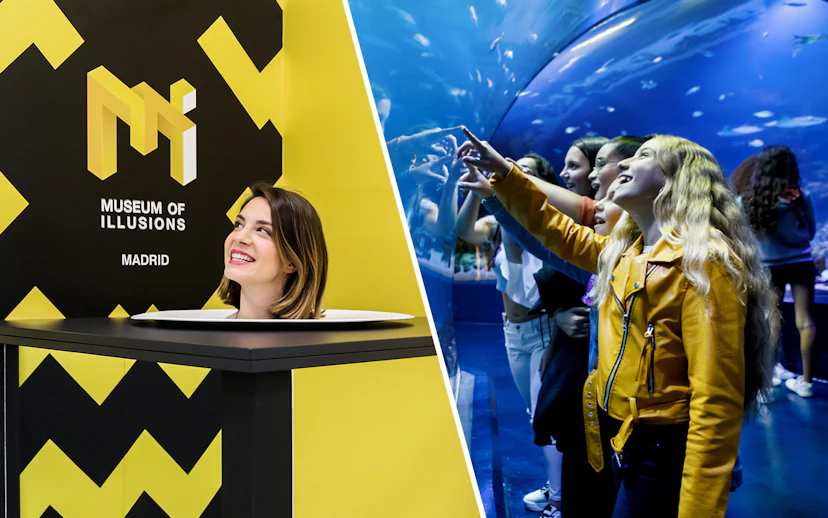
Combo with Aquarium Madrid | Entry to the Museum of Illusions, Skip-the-line tickets to Atlantis Aquarium | A fun-packed Madrid combo for curious minds and ocean lovers, with interactive illusions and an underwater adventure in one easy ticket. | From €24 |
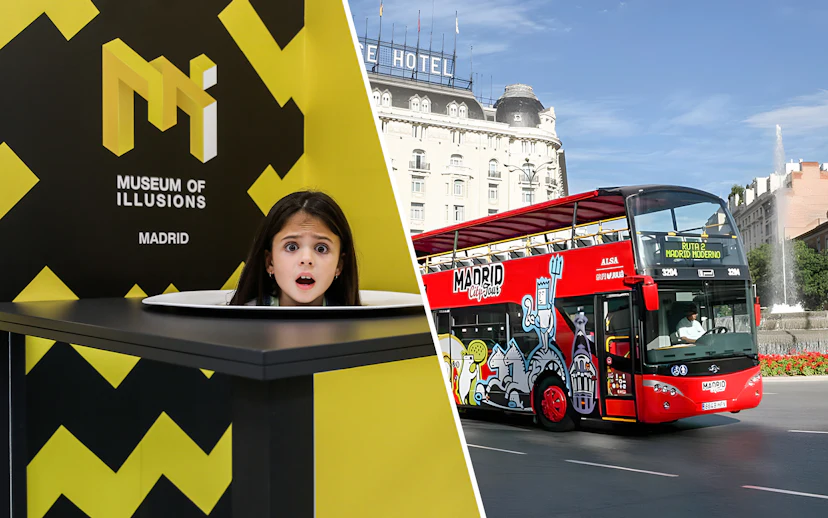
Combo with Madrid Hop-on-Hop-Off Bus Tour | Entry to the Museum of Illusions, 24-hour Hop-on Hop-off bus tour, Access to three routes, Guided walking tour & Audio guide | A flexible Madrid sightseeing combo that pairs immersive illusion rooms with convenient city-wide access to top landmarks and attractions. | From €43 |
How do you get around Museum of Illusions Madrid?
Layout and suggested route
Museum of Illusions Madrid is compact and zone-based rather than sprawling, with optical displays, immersive rooms, and interactive installations grouped into a short self-guided circuit. In practice, it is easy to navigate, but easy to rush if you go straight for the busiest rooms first.
- Optical illusions area: Holograms, perception tricks, and caption-led displays → budget 10–15 minutes.
- Immersive experiences area: Ames Room, Tilted Room, Vortex Tunnel, Infinity-style mirrored spaces → budget 20–30 minutes.
- Interactive installations area: Cloning Table, Beuchet Chair, Head on a Platter, and other camera setups → budget 15–20 minutes.
- Intelligent Games Room: Puzzles and brain-teasers → budget 10–15 minutes.
Maps and navigation tools
- Map: No detailed public visitor map is prominently published online → the route is short enough to manage on arrival without one.
- Signage: Wayfinding is usually sufficient for a compact self-guided visit, but room sequencing can feel tighter when the museum is busy.
- Audio guide / app: No public audio guide is clearly listed → bilingual exhibit captions do most of the interpretive work here.
💡 Pro tip: Save your longest photo stop for the second half of the route, not the first room you like, because many visitors burn time early and then rush the Cloning Table and puzzle area at the end.
What happens inside Museum of Illusions Madrid?

Ames Room
Room type: Perspective illusion
This is one of the museum's strongest crowd-pleasers because it makes one person appear tiny and the other oversized simply by where each stands. It works best when you slow down long enough to try both positions rather than taking one quick shot and moving on. Most visitors miss how dramatic the effect becomes when the photographer crouches slightly lower instead of shooting straight on.
Where to find it: In the immersive experiences section, after the caption-led illusion displays and before the later photo installations.
Vortex Tunnel
Room type: Walk-through motion illusion
The Vortex Tunnel is the room that most reliably changes people's pace, because the spinning cylinder creates the feeling that the floor is moving even though it is stable. It is brief, but it is the most physically disorienting part of the route and worth doing slowly. Most visitors rush straight through instead of pausing at the entrance rail to let their eyes adjust first.
Where to find it: In the immersive experiences section, on the main self-guided route between the perspective rooms and the later interactive installations.
Anti-Gravity Room
Room type: Tilt and balance illusion
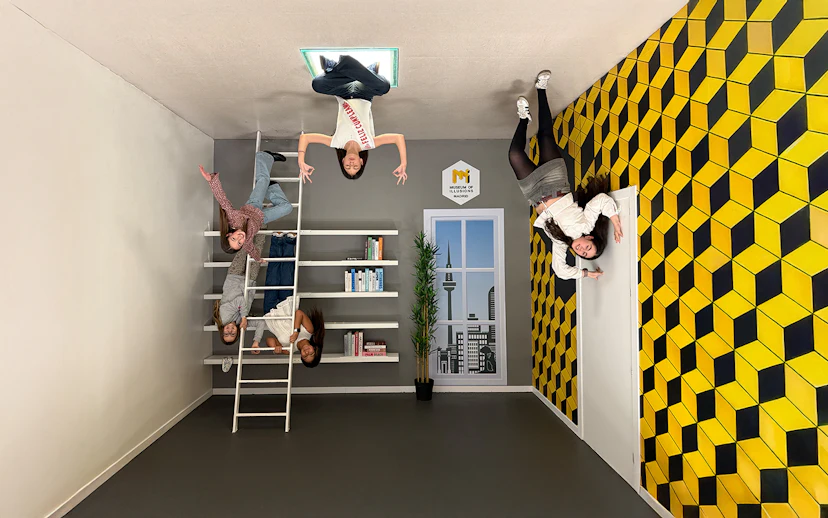
This room plays with your sense of vertical and makes simple poses look far stranger in photos than they do in person. It is more fun with two people, because one person can frame the shot while the other tests angles and balance cues. Most visitors do not realize the floor line is the detail that sells the photo, so they center themselves too early.
Where to find it: Along the immersive room sequence after the early optical displays.
Infinity Room
Room type: Mirrored immersive space
The Infinity Room gives you one of the museum's most atmospheric visual effects, using mirrors and repeated light points to create a much larger-feeling space than the museum actually has. It is one of the best reminders that this attraction rewards patience more than speed. Most visitors step in, snap one photo, and miss the better reflection if they shift slightly off-center.
Where to find it: In the immersive experiences section, deeper into the route after the larger perspective rooms.
Cloning Table
Installation type: Interactive photo setup
This is one of the easiest installations to underestimate because it looks simple until you see the final image. The effect is social and photo-led rather than physically immersive, which makes it a smart stop after the more dramatic rooms. Most visitors miss that it works far better when a second person takes time to frame the shot instead of relying on a fast selfie.
Where to find it: In the interactive installations section near the final part of the route.
Beuchet Chair
Installation type: Forced-perspective photo setup
The Beuchet Chair is designed for the kind of souvenir photo that makes people ask how it was taken. The illusion depends on exact placement, so it rewards a little patience more than some of the walk-through rooms do. Most visitors stand too close together, which weakens the scale trick that makes the installation work.
Where to find it: In the interactive installations zone, usually near the other staged photo illusions toward the end of the visit.
The Intelligent Games Room and the later interactive photo installations are easy to miss because many visitors mentally end the visit after the Vortex Tunnel and headline immersive rooms.
Facilities and accessibility
- 🛍️ Gift shop / merchandise: There is an on-site shop selling puzzles, games, and souvenirs, and it makes most sense as a quick final stop rather than part of the main visit.
- 🅿️ Parking: The museum states there is a private car park next to or on the same street, but remember the venue sits inside Madrid Central, so low-emission-zone access rules may affect whether driving is worth the hassle.
- 🎒 Stroller access: Strollers are allowed, which is useful in a compact, family-heavy attraction where carrying a tired child through the full route would get old quickly.
- 📧 Visitor support: The museum handles contact by email rather than phone, so if you need help with accessibility, timing, or rescheduling, it is better to ask ahead instead of assuming you can sort it out quickly at the door.
- ♿ Mobility: The museum is largely wheelchair accessible, but two rooms with inclines are exceptions, so this is mostly accessible rather than fully barrier-free end to end.
- 👁️ Visual impairments: No tactile map or public audio-description program is clearly listed on current visitor pages, so visitors who rely on these should contact the museum before booking.
- 🧠 Cognitive and sensory needs: No quiet hours or sensory guide are publicly listed, and several rooms are intentionally disorienting, so weekday opening slots are the safest choice if mirrored spaces, motion illusion, or visual overload are a concern.
- 👨👩👧 Families and strollers: Strollers are allowed and the route is short, but the most dramatic rooms can get cramped once group traffic builds, so earlier timed slots are easier with younger children.
Museum of Illusions Madrid works well for children who like hands-on spaces, visual tricks, and puzzles, especially if you treat it as a one-hour activity rather than a long museum day.
- 🕐 Time: 45–75 minutes is realistic with younger children, and the immersive rooms plus the puzzle area are usually the sections worth prioritizing.
- 🏠 Facilities: Stroller access is allowed, which makes the museum easier for families with very young children even though publicly listed family facilities are otherwise limited.
- 💡 Engagement: Let children guess how each illusion works before reading the caption, because the museum is more fun when they test their own explanation first.
- 🎒 Logistics: Bring a fully charged phone, arrive a little early for your timed slot, and skip bulky bags because the best rooms are tighter than the entrance location suggests.
- 📍 After your visit: Plaza Mayor is close enough for an easy walk, space to reset, and a snack stop without turning the day into another transit leg.
Rules and restrictions
What you need to know before you go
- Entry requirement: Standard entry is sold as a dated, timed slot, online bookings are prioritized, and box-office entry is only possible if availability remains.
- Bag policy: Public visitor pages do not clearly list locker or cloakroom details, so bring only a small bag you can comfortably carry through the full visit.
- Re-entry policy: A flexible re-entry policy is not clearly published, so treat your visit as one continuous circuit and plan snacks or breaks for afterward.
Not allowed
- 🚫 Food and drink: A public in-gallery food and drink policy is not clearly published, so it is safest to finish snacks before entering.
- 🚬 Smoking / vaping: Smoking rules are not separately published for the attraction, and this indoor venue is not the place to plan a smoke break mid-visit.
- 🐾 Pets: A public pet policy is not clearly listed on current visitor pages, so non-service animals should not be assumed to be allowed.
- 🖐️ Exhibit handling: Some installations are designed for interaction, but you should still follow staff instructions closely because the rooms depend on controlled positioning and safe movement.
Photography
- Photos and videos are encouraged at the Museum of Illusions Madrid, and that is a major part of the experience rather than a side note.
- The public visitor pages do not clearly set out room-by-room restrictions or detailed rules for flash, tripods, and selfie sticks, so the safest approach is to use a phone or compact camera, avoid blocking installations, and follow staff instructions in tighter rooms.
Good to know
- The Flex Ticket add-on is priced per person, not per booking, so it can change the value equation if only one person in your group actually needs schedule flexibility.
- The museum is small enough that late arrival matters more than people expect, because timed entry and compact rooms make delays harder to absorb than at a larger venue.
Practical tips
- Booking and arrival: Book your timed slot ahead if you are visiting on a weekend, school holiday, or rainy day, and aim to arrive 10–15 minutes early because this is a compact venue where late arrivals are harder to fold into the flow.
- Pacing: Save extra time for the interactive installations at the end, because many visitors spend too long in the first immersive rooms and then rush the Cloning Table, Beuchet Chair, and puzzle area.
- Crowd management: Tuesday to Thursday opening slots are the safest bet for clean photos and easier movement, while later Friday evening can work better than Saturday midday because family traffic has usually started thinning.
- What to bring or leave behind: Bring a fully charged phone and wear shoes you feel steady in, because the Vortex Tunnel and tilted rooms are more convincing than they look in photos and bulky bags get annoying fast in tight spaces.
- Food and drink: Treat this as a before-lunch, after-lunch, or rainy-day stop rather than a meal stop, because no on-site café is clearly published and you are only a short walk from Plaza Mayor, San Miguel Market, and Santa Ana.
- Expectations: This is a fun one-hour indoor experience, not a half-day museum, so it lands best when paired with nearby old-town wandering instead of carrying the full weight of your day.
- Accessibility planning: If anyone in your group is sensitive to vertigo, mirrored rooms, or motion illusion, email before booking and choose the earliest weekday slot so the most disorienting rooms feel calmer and less crowded.
What else is worth visiting nearby?
Commonly paired: Plaza Mayor
- Distance: 650m — 8-minute walk
- Why people combine them: It is the easiest same-neighborhood follow-on if you want the museum as a short indoor stop before lunch, coffee, or more old-town walking.
Commonly paired: Puerta del Sol
- Distance: 550m — 7-minute walk
- Why people combine them: Sol is a natural anchor before or after a timed museum visit, especially if you are arriving by metro or suburban rail and want minimal backtracking.
Also nearby
Mercado de San Miguel
- Distance: 850m — 11-minute walk
- Worth knowing: This is the strongest nearby food stop if you want tapas and variety right after your visit instead of searching for an on-site café.
Lope de Vega House Museum
- Distance: 900m — 12-minute walk
- Worth knowing: It pairs well if you want a complete contrast after the illusion-heavy visit. Smaller, quieter, and more literary-historic than playful.
Eat, shop and stay near Museum of Illusions Madrid
- On-site: No café is clearly published on current visitor pages, so it is better to treat the museum as a short attraction and eat before or after your slot.
- Mercado de San Miguel (11-minute walk, Plaza de San Miguel): Tapas market, medium to high price range, and the easiest all-in-one choice if different people in your group want different food.
- Plaza de Santa Ana terraces (8-minute walk, Plaza de Santa Ana): Casual cafés and sit-down options, medium price range, and a good fit if you want a slower break after a fast-paced visit.
- Chocolatería San Ginés (12-minute walk, Pasadizo de San Ginés, 5): Classic Madrid chocolate and churros, low to medium price range, and a smart pick if you want a recognizable post-visit treat near Sol and Plaza Mayor.
- Pro tip: Eat after your visit, not before, if you booked a fixed slot in the middle of the day, because the museum itself is short and nearby food options are more flexible than timed entry.
- Museum of Illusions shop: Puzzles, games, and souvenirs sold on-site, and the best buys are the take-home brain-teasers that extend the visit beyond the photo stop.
- Preciados and Sol shopping streets: Mainstream retail and souvenir shopping a short walk away, useful if you want to roll the museum into a broader central Madrid afternoon.
Yes for a short city break, especially if you want to walk almost everywhere. This part of Madrid is lively, central, and practical for fitting short-ticket attractions around food and major squares. It is less ideal if you want quiet nights or a slower local feel.
- Price point: Central and convenient, with rates that often run higher than less tourist-heavy neighborhoods.
- Best for: Visitors on a short trip who want to walk to Sol, Plaza Mayor, museums, and dinner without planning much transit.
- Consider instead: Barrio de las Letras if you want similar walkability with a slightly calmer feel, or Chamberí if you want a more residential base for longer stays.
Frequently asked questions about visiting Museum of Illusions Madrid
Most visits take 45–90 minutes, with the museum itself officially framed as about a one-hour experience. You might stay closer to 75–90 minutes if you take lots of photos, visit with children, or spend time in the puzzle and game areas. It is better planned as a short indoor stop than a half-day museum visit.
Yes, it is smart to book in advance, especially for weekends, school holidays, and rainy days. The museum uses timed entry, online sales are prioritized, and box-office tickets are only available if slots remain. Booking ahead matters more here than at larger museums because a compact venue feels crowded quickly.
Arrive 10–15 minutes early for your timed entry. That gives you enough buffer for check-in without turning a short visit into a rushed one. Because the museum is compact and timed, late arrival is more disruptive here than at a site where you can simply make up time later.
Yes, you can bring a small bag, but traveling light is the safer choice. Public visitor pages do not clearly list locker or cloakroom details, and the best illusion rooms are tighter than they look in photos. A small crossbody or day bag is much easier to manage than a bulky backpack.
Yes, photos and videos are encouraged, and they are a central part of the visit. The museum even advises visitors to arrive with a fully charged device. That said, you should still be considerate in compact rooms and follow staff directions if a setup needs people to move in a specific order.
Yes, it is one of the easier central Madrid attractions to do with children, especially if they enjoy hands-on spaces and visual tricks. Most families do well with a 45–75 minute visit. The key is matching expectations: it is playful and interactive, but still relatively compact.
Mostly yes, but not completely. The museum states that it is wheelchair accessible except for two rooms with inclines, so most of the route works but not every space is fully barrier-free. If full-room access matters to your visit, it is worth contacting the museum before booking.
Food is easy to find nearby, but no on-site café is clearly published on current visitor pages. That is not a major problem because the museum is in central Madrid and within a short walk of Plaza Mayor, Puerta del Sol, San Miguel Market, and Santa Ana. It is easiest to plan food before or after your slot.
Yes, box-office sales exist, but they depend on availability and are not the safest plan. The museum prioritizes online bookings, so same-day walk-up visitors may find their preferred slot gone, especially at busy times. If timing matters to your day, book ahead instead of gambling on the door.
It can be challenging if you are sensitive to motion illusion, mirrored rooms, or disorienting spaces. The Vortex Tunnel and tilted or altered-gravity rooms are designed to disturb your sense of balance. If that sounds like a problem, choose a quieter early weekday slot and contact the museum in advance for the most up-to-date guidance.